
I Miss Tadej. I’m Also Glad He’s Not Racing.
May 2019 is when I first heard the name Tadej Pogacar. The then 20 year old grabbed the win at Tour of California, making him the youngest ever UCI World Tour stage race winner.
I’m tickled by this quote in the San Diego Tribune that reads, “Asked where the relatively unknown Pogacar picked up his beyond-his-years poise and tactics, he replied: ‘I think from all the racing over the years, with great coaching. I’ve been racing 10 years now and you learn stuff. But I still don’t know everything.’” He learned a lot those first 10 years of racing. Now six years later, he’s clearly learned a whole lot more.
Fast-forward to the present and I’m not alone when I tune into a race, watch Tadej attack with 90 minutes of racing yet to go knowing he’s going solo to the finish, and think, “Gosh, raceswithoutTadej are much more exciting to watch.”
Don’t take that the wrong way. I love watching greatness. Witnessing Tadej duke it out in a Grand Tour is something I eagerly gobble up, just as I love watching him go toe-to-toe in a one-day Monument. He’s the best of all time, and it’s exciting to watch him continually rewrite the record books.
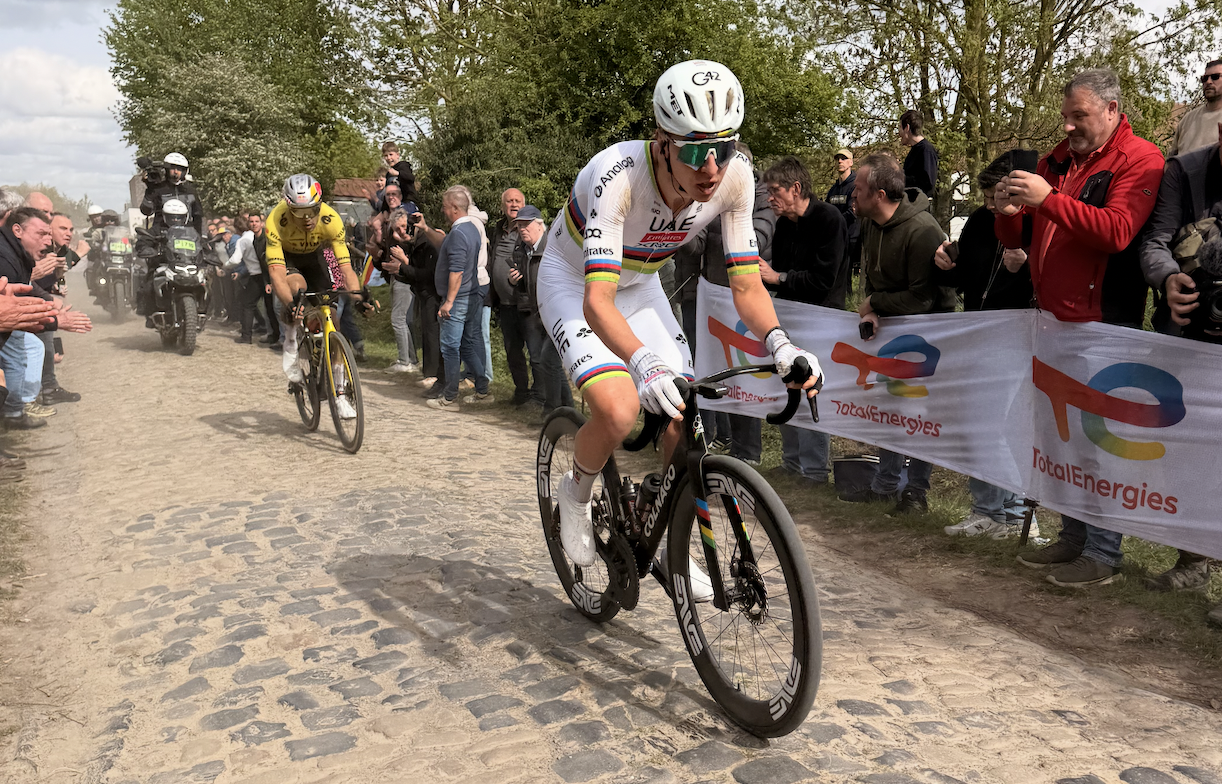
In fact, that’s one of the things that makes cycling such a great sport to watch. From the general classification to the hunt for stage wins, intermediate classifications and the battle for the podium, there’s almost always something going on. There are multiple races happening within the race.
Except when Tadej has his jaws locked on all of it at once.
General classification? Yep.
Stage wins? Sure.
Intermediate classifications? Icing on his cake.
He’s an abominable giant.
Which is why it’s so interesting that there was a collective sadness when Tadej exited the Vuelta. The peloton didn’t quite know how to react. The announcers scrambled for what to say. Of course, nobody wants to see someone get hurt in a bike race. His race-ending crash was dramatic, high-speed, and violent. Watching him scramble around like an injured bird, trying to collect himself and decide whether he could remount, was genuinely sad.
But then something else happened.
The Vuelta immediately became more wide open. More unpredictable. More interesting.
And still, everyone in the cycling world let out a sorrowful sigh.
That’s the strange thing about watching Tadej race right now. We want him there because he’s writing history. But we also want him absent from races because he makes it look so boilerplate. Among the best in the sport, he makes it look like a pro racing amongst cat 4s.
The same can be said about the upcoming World Championships and Tadej’s absence there. Peter Sagan is the only male cyclist to have won the UCI Road World Championships three consecutive years. Cycling is a sport without many guarantees, but it seems nearly certain that Tadej would have wrapped up the same achievement on a course perfectly suited to him in Montreal.
So once again, we’re left with that strange combination of disappointment and excitement: disappointed that Tadej won’t be on the start line, but excited that the race is suddenly wide open for any number of different winners.
Either way, I’ll be glued to the action.
I’ll be watching to see who finishes in red in Spain, and who takes the rainbow bands in Montreal.
And, perhaps more importantly, I’ll be watching to see what happens when the abominable giant isn’t there to eat the whole race.